
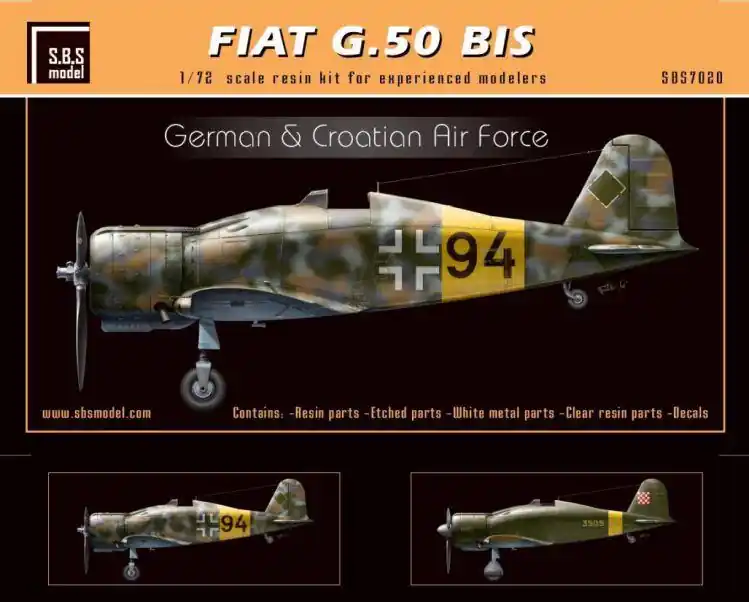
Fiat G.50 bis Sconto
Il prezzo originale era: 50,00 €.26,00 €Il prezzo attuale è: 26,00 €.
1/72 Fiat G.50 bis ‘German & Croatian Air Force’
The Fiat G.50 was an Italian fighter aircraft developed and manufactured by Fiat Aviazione during the late 1930s and early 1940s. It was designed by renowned aviation engineer Giuseppe Gabrielli. The G.50 was utilized primarily by the Regia Aeronautica, the Italian Royal Air Force, during World War II.
Key features of the Fiat G.50 included:
Design and Performance: The G.50 was a monoplane with a retractable undercarriage and enclosed cockpit. It was a sleek and modern design for its time. Its performance was respectable, although it began to lag behind other contemporary fighter aircraft as the war progressed.
Armament: The aircraft was armed with a mix of machine guns and cannons. Early versions were equipped with four 12.7mm Breda-SAFAT machine guns, while later variants incorporated additional weaponry like 20mm or 12.7mm Breda-SAFAT cannons.
Service History: The Fiat G.50 initially saw combat during the Spanish Civil War on the side of the Nationalists. It was considered competitive at the time, but it quickly became outdated in comparison to newer and more advanced fighter aircraft. It saw limited service on the Eastern Front during World War II and was mainly used in secondary roles such as ground attack and training as the war progressed.
Variants: The G.50 went through several modifications and versions, including naval variants and experimental versions with different engines and armament setups. One notable variant was the G.50B, which had improved armor protection.
Legacy: While the Fiat G.50 did not have a significant impact on the overall outcome of World War II, it played a role in the early stages of the conflict, particularly in the Mediterranean theater. Its design elements influenced subsequent Italian fighter designs, but it was not as successful as some of its contemporaries.
Overall, the Fiat G.50 was a capable fighter for its time, but it struggled to keep up with advancements in aviation technology as the war progressed. It serves as a representation of the challenges faced by Italy in maintaining competitive air forces during World War II.
Prodotti correlati
-
In offerta!

NOCH 15635 SET PERSONAGGI: bambini con pony – 1/87 A Buon Prezzo
Il prezzo originale era: 9,95 €.5,17 €Il prezzo attuale è: 5,17 €. Aggiungi al carrello -
In offerta!

Subito Disponibile NOCH 15565 SET PERSONAGGI: scene di città – 1/87
Il prezzo originale era: 11,90 €.6,19 €Il prezzo attuale è: 6,19 €. Aggiungi al carrello -
In offerta!
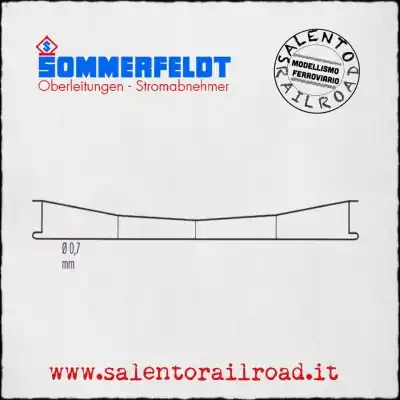
Offerta Limitata SOMMERFELDT 145 catenaria in acciaio ramato 0,7mm – lunghezza 270 mm – 5 pz
Il prezzo originale era: 12,90 €.6,71 €Il prezzo attuale è: 6,71 €. Aggiungi al carrello -
In offerta!

Popolare NOCH 14050 piante da giardino – 17 pezzi in scala 1:87
Il prezzo originale era: 10,00 €.5,20 €Il prezzo attuale è: 5,20 €. Aggiungi al carrello